Guide
Should you ban AI at work?
It's the first instinct after you find out what your team is doing, and it feels responsible. But a ban doesn't get you to zero AI — it gets you to zero visibility. Here's the difference, and what to do instead.
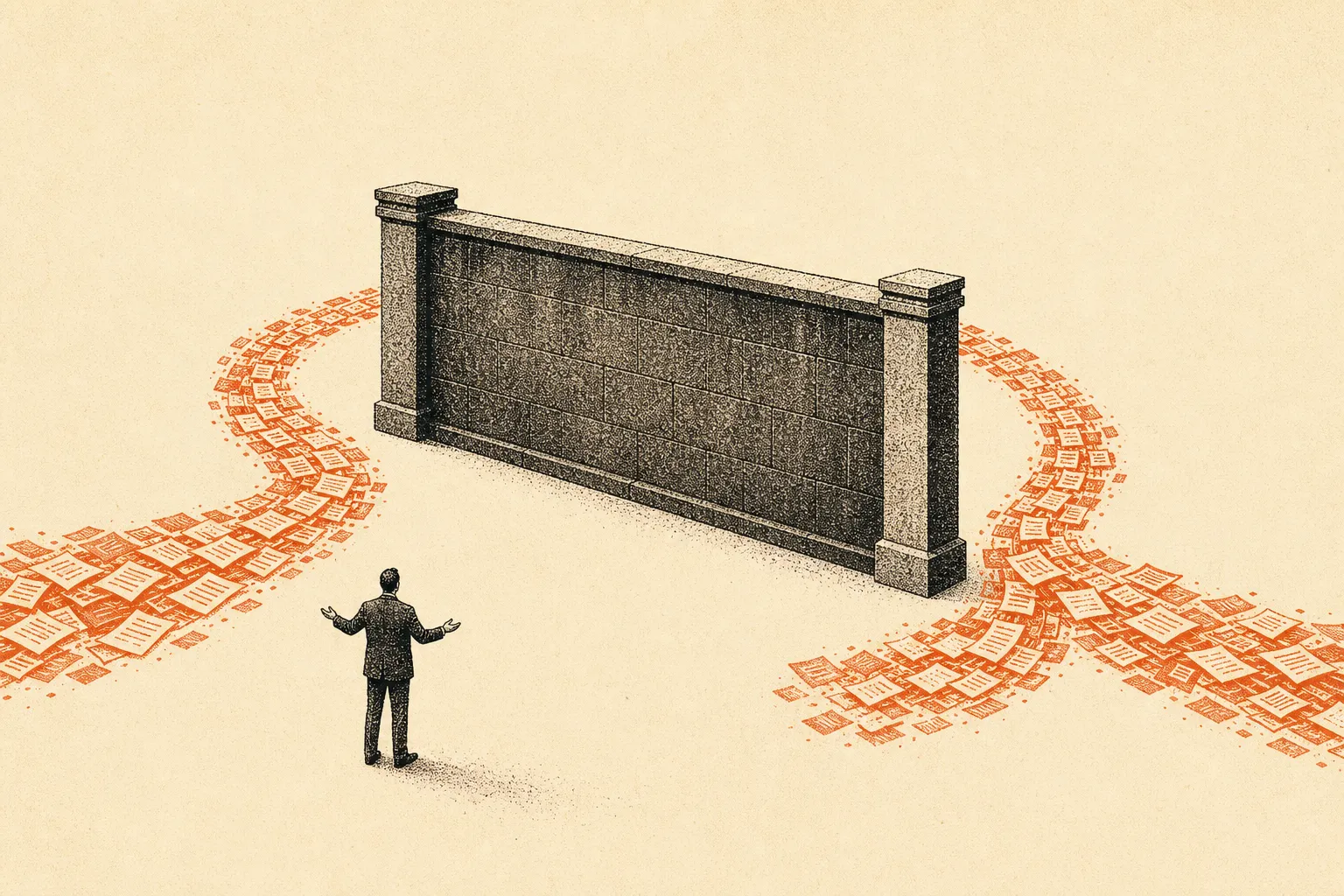
Once an owner sees what their team is actually pasting into AI tools, the next question is almost always the same, and it’s a fair one: should we just ban it?
It feels like the responsible move. Draw a line, send the email, close the exposure. I understand the instinct completely — but the answer is no, and not for the reason you’re bracing for. This isn’t the “AI is inevitable, get on board” speech. It’s simpler and more practical than that: a ban doesn’t do the thing you want it to do.
The ban you can write and the ban you can enforce
Here’s the distinction the whole question turns on.
You can ban AI on paper in an afternoon. Write the policy, announce it, add it to the handbook. Done.
You cannot ban it in reality, because of what the tool physically is. It’s a website, open on a device. Your best data-loss controls assume a chokepoint — email routes through a server you run, USB ports can be disabled, file shares have permissions. A chat box has none of that. There’s no log and no chokepoint, which is the same reason you couldn’t see the usage in the first place.
So block the site on the office network, and the phone in their pocket isn’t on the office network. Neither is their laptop at home, or the guest wifi, or a personal hotspot. The paste still happens. You’ve just moved it somewhere with even less oversight than before.
That’s the trap. A ban doesn’t take you from “lots of AI” to “no AI.” It takes you from “AI you can see” to “AI you can’t.” You’ve converted a visible problem into an invisible one and told yourself you solved it.
What the ban actually costs
Suppose it half-works — usage drops, at least among the people who follow rules. Look at who that is.
The people who follow the ban are your conscientious ones. The people who quietly keep using AI on their phone are the ones for whom it’s genuinely load-bearing — your most effective people, on your most painful work. So a ban lands hardest on exactly the wrong group: it slows the compliant and barely touches the determined.
And it costs you something you can’t easily get back. The single most valuable thing to come out of the amnesty conversation is the map of where the work hurts — people reach for AI precisely where their job is worst, and that ranking is free R&D you can’t buy. Ban the tool and that signal goes dark. Your early adopters stop volunteering what they’ve figured out, because now it’s a confession. You don’t just lose visibility into risk. You lose the intelligence that would have told you what to fix.
The thing about a ban is that it’s legible. It looks like action, it’s easy to point to in a meeting, and it lets everyone move on. That’s exactly why it’s tempting and exactly why it’s dangerous — it produces the feeling of having handled it while the actual exposure carries on, now underground.
The one kind of “no” that does work
There’s an important exception, and it’s the reason this gets muddled.
A ban on a category fails — “no AI,” “don’t use ChatGPT.” A rule about specific behavior with specific data can work, because it’s narrow enough to understand and to mean. “Client records and anything under an NDA never go into a general AI tool, full stop” is enforceable in the only way that matters: a reasonable person can hold it in their head and apply it at 4:50pm on a deadline.
The difference is that the second one isn’t really a ban on AI. It’s a rule about a handful of things that are dangerous regardless of the tool — the material that shouldn’t go into any external service, AI or not. You’re not prohibiting a category of software. You’re naming the few things that are genuinely radioactive and drawing a hard line around those. That line is short, and short is what gets followed.
So the useful move isn’t “ban AI.” It’s “ban these three specific things everywhere, and give people a safe place to do everything else.”
The reason they reached for it in the first place
Here’s the part that reframes the whole problem.
Your team didn’t paste a client contract into a personal ChatGPT because they’re reckless. They did it because, at that moment, it was the best tool available to them. It was right there, it worked, and nothing better was on offer. That’s not a discipline failure. It’s a supply problem — the safe option didn’t exist, so they used the one that did.
A ban attacks the demand. It tells effective people to be less effective and hopes they comply. That fights human nature, and human nature has a strong track record.
The alternative attacks the supply. Give them a sanctioned tool that’s genuinely as good — a business account your company controls, that doesn’t train on your data, that you can see and switch off — and the reason to reach for the shadow version evaporates. You don’t have to win an argument about willpower. You just have to make the safe path the easy path, and then it wins on its own.
That’s the whole game: not making AI harder to use, but making the right AI the most convenient thing in reach. People take the path of least resistance. Your job is to make sure the least-resistance path is also the safe one.
What to do instead of banning
Concretely, and in order:
- Don’t ban the category. You’ll lose visibility and slow your best people, and it won’t hold.
- Do ban the few things that are genuinely dangerous — client-confidential material, anything under contract, credentials, regulated personal data — everywhere, on every tool, in one page of plain language.
- Stand up a sanctioned option that’s actually good, on accounts you administer, so the safe path is also the convenient one. If the official tool is worse than the shadow one, people will keep using the shadow one, and you’ll have earned nothing.
- Tell people it exists and that it’s fine to use. A sanctioned tool nobody knows about is just a licence you’re paying for while the exposure continues.
The goal was never zero AI. Zero AI isn’t achievable, and chasing it just buys you the illusion of safety over the real thing. The goal is that the AI happening in your business is visible, deliberate, and on ground you control — and you get there by out-competing the shadow tool, not by outlawing it.
That’s the conversation worth having, and it’s a solvable one. The hard part isn’t saying no. It’s making yes safe enough that no isn’t necessary.